
From the outside, timeshare rental companies all describe themselves the same way.
They will rent your points. You will get paid.
The differences are underneath that, in two places: when the booking gets made, and how the payout gets calculated.
This is the one that decides whether your points convert at all.
Most companies take your points and make reservations based on what they think will rent.
Popular resorts. Peak dates. Large units.
Then they list those reservations and wait to find a renter.
Sometimes that works.
A lot of the time the market is already saturated with owners doing exactly the same thing, and the booking sits.
| Step | Typical Rental Company | The Approach Here |
|---|---|---|
| Booking | Books first, hopes it rents | Matches real demand first |
| Risk | Inventory may sit unused | Bookings tied to a real guest |
| Owner involvement | Often required | Hands-off |
| Payouts | Vary by where bookings fell | Averaged across the tier |
Guests are already in a queue requesting specific resorts, specific dates, and specific unit sizes.
When your points are assigned, they are matched against those requests.
The reservation is made after the guest exists, not before.
So the value is attached the moment the booking happens.
Matching only works if there are enough guests to match against.
That comes from distribution:
And software that confirms the dates a guest is asking for are genuinely available in your account before anything is reserved.
Most of the industry runs a 60/40 split on each reservation.
That sounds fair until you look at what it does to two similar owners.
Take two owners with the same points and the same VIP tier.
Both assign the same amount.
Under a 60/40 split, they can still be paid different amounts, purely because of where their individual bookings happened to land.
Nobody controls the market. Rates move constantly, and price points have to stay somewhere a guest will actually book.
So one owner has a good month and the other does not, for reasons neither of them influenced.
The approach here is to average the yield across the tier instead.
The comparison that fits best is an index fund.
If two people put the same amount into the same fund, they get the same dividend.
Put in more, get more.
Same idea. Payout is based on the average yield for your tier that month, applied to the points you rented.
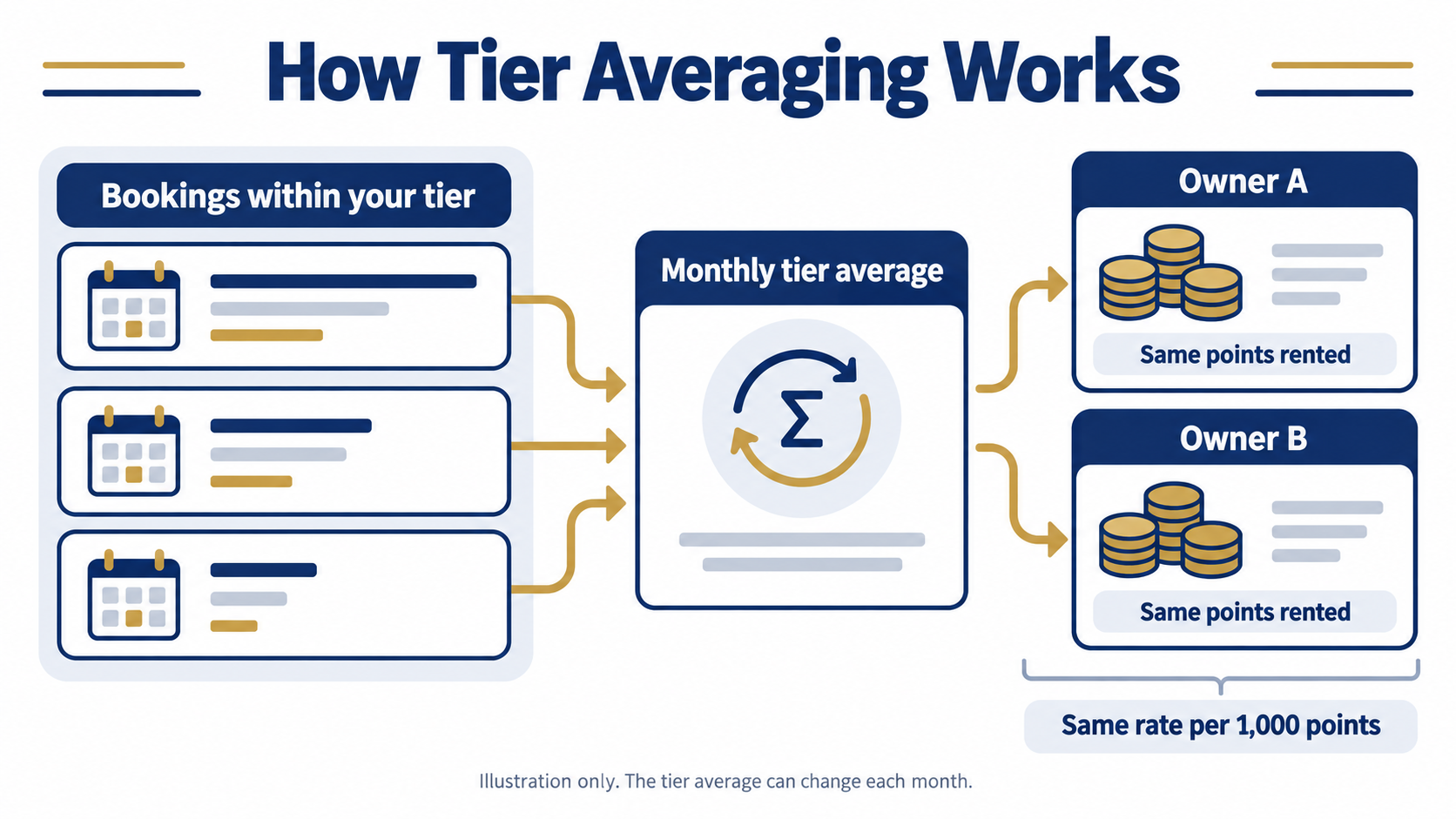
If the average yield on a month of checkouts is $10 per 1,000 points, an owner who rented 1,000,000 points is paid $10,000. An owner who rented 700,000 is paid $7,000, and their remaining points pay out when those stays check out.
You are no longer exposed to which specific reservations landed in your account.
Two owners in the same tier who assign the same points get the same result.
It does not remove the market. Yields still move month to month.
It removes the part where identical owners get different answers.
If you are comparing options, the two questions that separate them are:
Most of the rest is presentation.
Both differences point the same direction.
One is about whether your points convert at all.
The other is about whether the number you get is predictable once they do.
Those are the two things worth comparing.
Get started by sharing a few details with our team.
We will reach out for a quick, free, and no-obligation call.


