
Most owners do not realize there are two completely different ways rentals happen.
On the surface, they sound similar.
In practice, they lead to very different outcomes.
The two approaches are:
That is the real split.
This is what most companies do.
They take your points and make reservations based on what they think will rent.
Usually:
Then they list those reservations and wait.
Sometimes it works.
But a lot of times:
Reservations are made first, then listed in hopes of finding a renter.
The issue is not effort.
It is timing.
By the time the reservation is made:
So now you are stuck with inventory that costs points and is not generating anything.
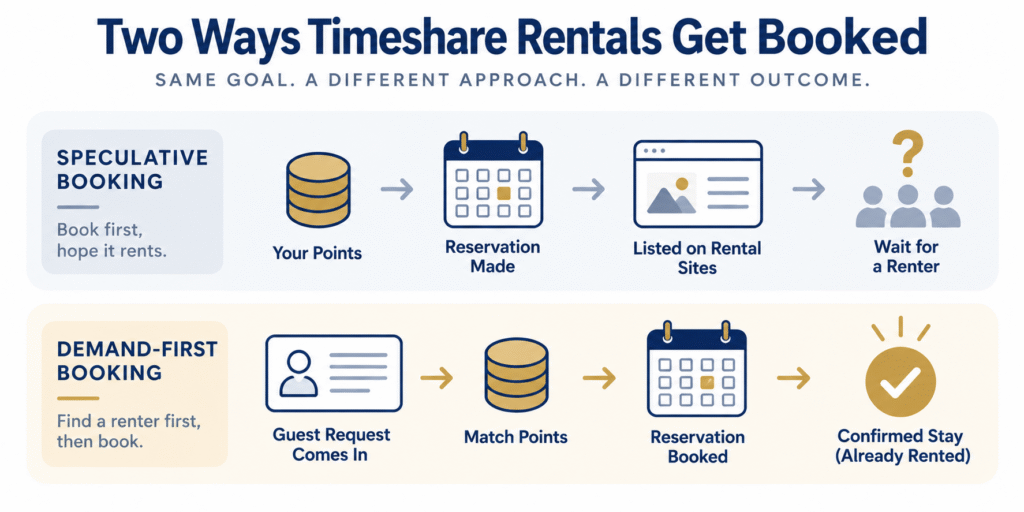
This flips the order.
Instead of guessing, it starts with actual guest requests.
People are already searching for:
That demand exists before anything is booked.
When points are assigned, they are matched against real requests.
Example:
A guest is looking for a two-bedroom, at a specific resort, on set dates.
If that lines up with your points, the reservation is made.
At that moment, the stay is already connected to a guest, and the value is already there.
There is no waiting to see if it rents.
With speculative bookings, you are creating supply first, then hoping demand shows up.
With demand-first, demand already exists, and supply is created to match it.
That is a big difference.
| Approach | Order | Outcome |
|---|---|---|
| Speculative | Book, then find a renter | Inconsistent results |
| Demand-First | Find a renter, then book | More consistent bookings |
If bookings are made without demand:
If bookings are tied to demand:
From the outside, both approaches look the same.
You hear:
“We’ll rent your points”
But what matters is when the booking is made.
Before demand? Or after demand?
That is the part most people do not ask about.
One model is guessing.
The other is matching.
Demand-first does not mean:
There is still a market behind it.
It just removes the biggest risk: creating bookings no one asked for.
If you have ever had a rental that just sat there, this is usually why.
It was not tied to real demand.
Once that piece changes, the rest of the process tends to fall into place.
Get started by sharing a few details with our team.
We will reach out for a quick, free, and no-obligation call.


